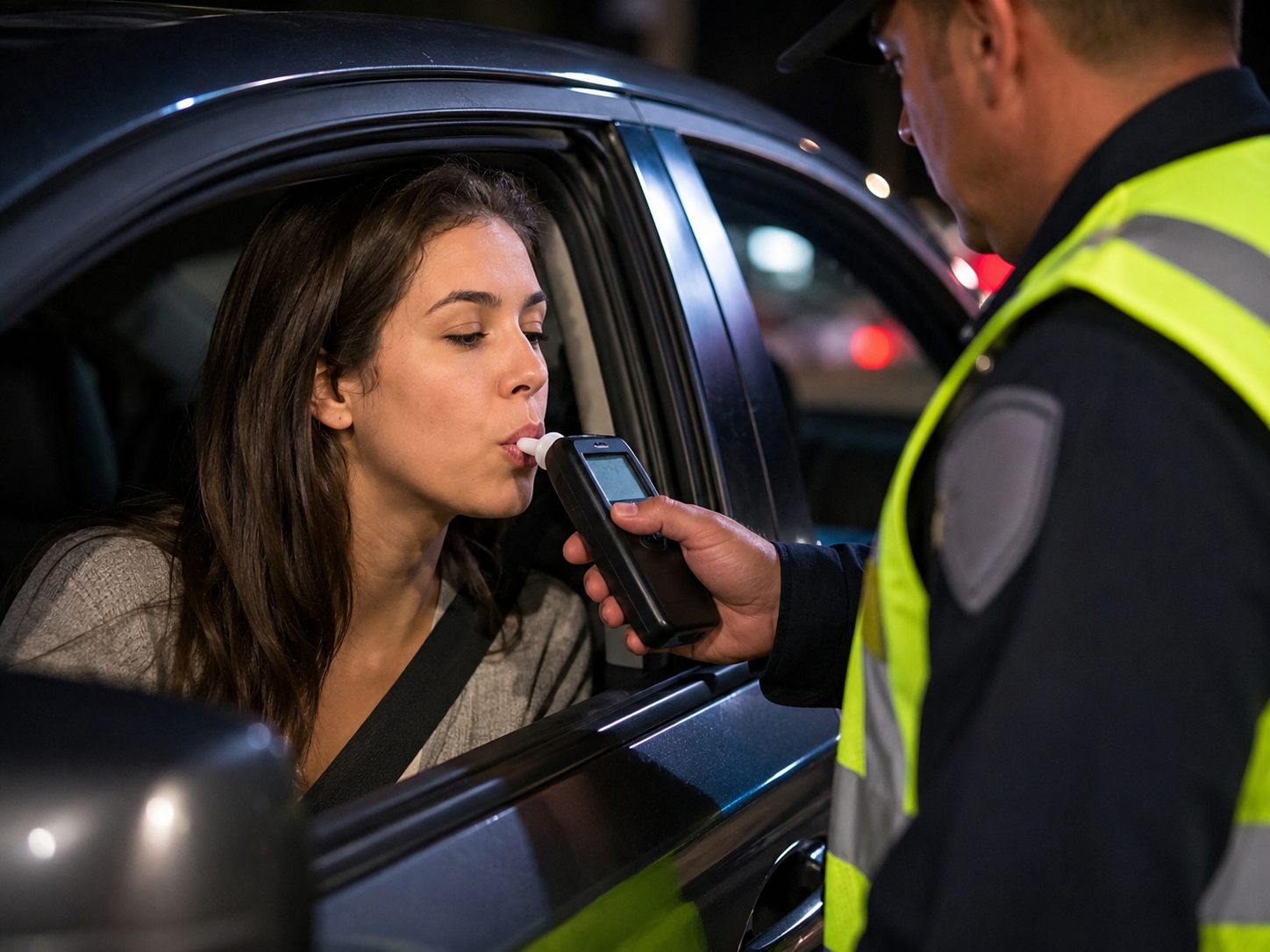
You are stopped while driving in Media, Delaware County, or somewhere else in Southeastern Pennsylvania. Police suspect that you have been drinking and arrest you for DUI. But afterward, one part of the case may not make sense: There is no BAC result.
If there is no breath or blood-test number showing that your blood alcohol concentration was .08% or higher, how can you still face a DUI charge?
In Pennsylvania, a BAC result is not required for every type of alcohol-related DUI. Under the state's general-impairment law, the Commonwealth may rely on driving behavior, police observations, statements, field sobriety testing, video, witness testimony, and other admissible evidence to prove that alcohol rendered someone incapable of safely driving.
The absence of a BAC result therefore does not automatically end a DUI case. But it changes what the Commonwealth must rely on to try to prove the charge.
Why Doesn't Every Pennsylvania DUI Require a .08 BAC?
Pennsylvania law provides more than one way for the Commonwealth to pursue an alcohol-related DUI.
Under 75 Pa.C.S. § 3802(a)(1), a person can be charged with general impairment if, after consuming alcohol, the person drives, operates, or exercises actual physical control of a vehicle's movement while incapable of safely doing so. That provision does not require the Commonwealth to prove a specific BAC.
Other portions of Pennsylvania's DUI law establish offenses based on specified blood or breath alcohol concentrations. A BAC of .08% is therefore important for certain BAC-based DUI provisions, but it is not the only way Pennsylvania law addresses alcohol-impaired driving.
That distinction becomes especially important when there is no chemical-test result, because the case may depend much more heavily on what police observed before, during, and after the stop.
What Evidence Can the Commonwealth Use When There Is No BAC Result?
Without a chemical-test result, other evidence can become particularly important.
Depending on the circumstances, police and prosecutors may point to:
- The way the vehicle was being driven before the stop
- An accident or unusual driving behavior
- The odor of alcohol
- The driver's speech, balance, coordination, appearance, or behavior
- Statements about drinking
- Performance on field sobriety tests
- Body-camera or dash-camera footage
- Witness observations
- What officers observed before, during, and after the stop
No single observation necessarily answers the question by itself. An odor of alcohol, for example, may indicate that someone consumed alcohol, but alcohol consumption alone is not the same as establishing that the person was incapable of safely driving.
The important question is what the admissible evidence, considered together, actually establishes about the driver's condition and ability to operate the vehicle safely.
Can the Commonwealth Prove DUI Without a BAC Result?
Potentially, yes.
In a general-impairment case, the Commonwealth does not need a particular BAC number if other admissible evidence proves beyond a reasonable doubt that alcohol rendered the person incapable of safely driving, operating, or controlling the movement of the vehicle.
That proof may be circumstantial. The issue is not simply whether the driver consumed alcohol, but whether the evidence establishes the level of impairment required by the specific charge.
A missing BAC result does not lower the Commonwealth's burden of proof or create a presumption either way. The prosecution must still establish every required element of the offense beyond a reasonable doubt.
Why Might There Be No BAC Result?
Not every case without a BAC result arises for the same reason.
A driver may have refused a requested chemical test. In another case, a sample may not have been obtained, testing may not have produced a usable result, or another issue may affect whether chemical-test evidence is available.
That distinction matters.
A refusal covered by Pennsylvania's implied-consent law can raise separate issues, including potential driver's-license consequences. In a DUI proceeding, evidence that a driver refused qualifying chemical testing may also be introduced along with the circumstances surrounding the refusal, although the refusal itself does not create a presumption. This is different from Pennsylvania's preliminary roadside breath test, which is used before arrest to help an officer determine whether an arrest should be made and is treated differently under the implied-consent statute.
A refusal case therefore should not automatically be treated the same as a case in which there simply is no usable chemical-test result for another reason.
The first question should be why no BAC result exists and what legal significance that has in the particular case.
At The Law Offices of Joseph Lesniak, LLC, we start by identifying why the BAC result is unavailable and how that affects the specific DUI charge before evaluating the other evidence in the case.
What Should Be Reviewed in a DUI Case Without a BAC Result?
When there is no BAC number, the details surrounding the arrest can become especially important.
Body-camera and dash-camera footage may show whether the officer's written description matches what was actually recorded. The circumstances surrounding field sobriety testing may also matter, including how testing was administered and the conditions under which it occurred.
Other evidence may help explain particular observations attributed to alcohol or a driver's performance during field sobriety testing. Physical or medical conditions, road or surface conditions, footwear, lighting, weather, fatigue, injuries, or other circumstances may be relevant when they bear on what an officer observed or how a test was performed.
The sequence of the DUI investigation should also be examined. What did the officer observe about the driver's condition? What did the driver actually say? How were field sobriety tests administered? Why was no chemical result obtained?
Most importantly, the evidence should be evaluated for what it actually establishes. Evidence that an individual consumed alcohol is not automatically proof that alcohol rendered that person incapable of safely driving.
Does Having No BAC Result Mean Your DUI Will Be Dismissed?
No. The absence of a BAC result, by itself, does not require dismissal of a Pennsylvania DUI charge.
Whether a charge can ultimately be sustained depends on the specific offense and the admissible evidence supporting it. In a no-BAC case, that can make the accuracy and consistency of the remaining evidence especially important.
Police reports can be compared with available video, witness accounts, driving observations, statements, and the circumstances surrounding any field sobriety testing. If those sources tell different stories, those differences may matter when the strength of the Commonwealth's case is evaluated.
The key point is that the absence of a BAC result is neither an automatic defense nor proof that the charge is justified.
What Should You Do After a DUI Arrest When There Is No BAC Result?
If you have been charged with DUI and there is no BAC result, do not assume that this fact alone determines what will happen.
Preserve the paperwork you received after the arrest along with any photographs, videos, receipts, witness information, or other materials that may help establish the timeline. If a medical condition, medication, injury, or other circumstance may be relevant to what an officer observed, preserve that information as well.
The reason there is no chemical-test result should also be identified rather than assumed.
A careful review can then focus on which DUI provision the Commonwealth is relying on, why no BAC result is available, and whether the remaining evidence actually proves general impairment.
Reviewing a DUI Charge When There Is No BAC Result
A missing BAC result changes the evidence available in an alcohol-related DUI case, but it does not answer whether general impairment can be proven. The specific DUI charge, the reason chemical-test evidence is unavailable, and the remaining evidence of impairment all need to be evaluated together.
At The Law Offices of Joseph Lesniak, LLC, headquartered in Media, we represent people facing DUI and other criminal charges throughout Delaware County and Southeastern Pennsylvania. We can review what happened during the stop, determine why no BAC result is available, evaluate the evidence the Commonwealth may rely on, and explain what the charge means for you moving forward.
Contact The Law Offices of Joseph Lesniak, LLC for a free consultation to discuss your DUI charge and understand what may come next.
Disclaimer: The articles on this blog are for informational purposes only and are no substitute for legal advice or an attorney-client relationship. If you are seeking legal advice, please contact our law firm directly.